
Navigating our reports Te wherawhera i ā mātau pūrongo

Navigating our reports |
Te wherawhera i tēnei pūrongo
This report has three parts. Part 1 sets the scene, describing the scope and purpose of this second phase of the Royal Commission of Inquiry into COVID-19 Lessons Learned. It also explains three significant contextual factors that shaped the pandemic response: the legal framework, government decision-making arrangements and structures, and the changing course of the pandemic itself. This context is reflected in our analysis of key decisions elsewhere in the report.
Part 2 addresses the first of the two primary tasks we were asked to carry out. Across four chapters, we review and assess the key decisions Government made during 2021 and 2022 in the following areas of the response:
- vaccine approval and safety (Chapter 2.1)
- vaccine mandates, including the introduction of the Vaccination
Assessment Tool and vaccine passes (Chapter 2.2) - the procurement, development and distribution of testing technologies
(Chapter 2.3), and - national and regional lockdowns (Chapter 2.4).
On each topic, the chapter begins by documenting what happened in the period under review: the key decisions taken, the advice and information on which they were based, the mix of factors decision-makers took account of and the consequences of decisions. We then present our overall assessments of those decisions.
In Part 3, the report’s focus moves from the past to the future. It addresses the second of our primary tasks: identifying the lessons learned from New Zealand’s COVID-19 response and making recommendations to better prepare the country for future pandemics. The lessons capture four fundamentals that – on the basis of our assessment of New Zealand’s COVID-19 experience – we consider should underpin future pandemic responses:




Some lessons lead to recommendations – practical steps that we urge the Government to implement as soon as possible. Other lessons address wider global problems that are beyond the scope of any single government to solve. Even here, however, our lessons identify things that Aotearoa New Zealand can do to anticipate, prepare for,
mitigate and recover from the adverse effects of a pandemic – for example, monitoring, learning from other jurisdictions, international collaboration and modelling.
Three appendices provide supplementary and contextual information. Appendix 1: Understanding the science of vaccines presents expert scientific evidence that responds to vaccine safety concerns raised by submitters. Appendix 2: Lockdown decisions and criteria for changing alert levels comprises a region-by-region chronology of when (and why) it was decided to use or extend lockdowns in Auckland, Northland and Waikato, and to change or maintain alert levels more generally. Finally, a Glossary lists and defines terms used throughout the report, including the names of agencies and organisations.
Readers can also refer to the supplementary material released alongside this report and available on the Inquiry’s website, including transcripts of interviews and :
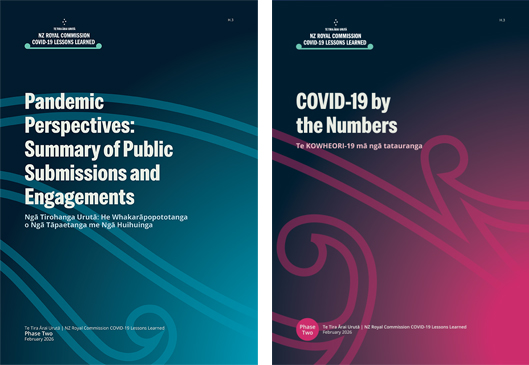
- Pandemic Perspectives report
A thematic summary of the public submissions we
received, as well as information provided by sector
and regional body representatives.
Visit:
www.covid19lessons.royalcommission.nz/reports
lessons-learned/phase-two/pandemic-perspectives
- COVID-19 by the Numbers
A compilation of publicly-available statistics and
commissioned research about the pandemic and
its consequences.
Visit:
www.covid19lessons.royalcommission.nz/reports
lessons-learned/phase-two/
covid-19-by-the-numbers