
3.4 Lesson Four: Readiness for social impacts and post-pandemic recovery Wāhanga Tuawhā: Te Rite mō ngā pānga ā-pāpori me te whakaoranga ā-muri i te Mate Urutā

3.4 Lesson Four: Readiness for social impacts and post-pandemic recovery
Wāhanga Tuawhā: Te Rite mō ngā pānga ā-pāpori me te whakaoranga ā-muri i te Mate Urutā
L4.1 Lesson Four in brief
Wāhanga Tuawhā: Te Kōrero Poto
Government agencies should take the opportunity now to better understand the impacts of the COVID-19 pandemic and the pandemic response on the reach and quality of public services. Doing so will mean they are better able to minimise and mitigate the impacts of service disruptions in a future pandemic and can learn from each other.
Ministers should set clear expectations that their agencies will use the experience of COVID-19 to evaluate and assess services, plan for maintaining service delivery during a pandemic, and identify which services will require the most attention to catch up on lost or disrupted delivery.
New Zealanders showed considerable resilience in the face of COVID-19 and the response to the pandemic. Nevertheless, there were clear impacts we can learn from. The disruption of some public services during the pandemic had long-lasting effects, including on key preventative health programmes such as childhood immunisation and cancer screening. While service disruption may be inevitable during a pandemic, it is possible to mitigate some impacts through planning, agility and new approaches.
Public trust in government and social cohesion came under increasing pressure as the pandemic progressed. New Zealand went into the COVID-19 pandemic with deep reserves of trust and these were boosted further with early successes in eliminating the virus. However, adherence to lockdown restrictions began to wane as more of the population was vaccinated and people increasingly questioned whether some restrictions were still proportionate to the risks.
Declining levels of trust and social cohesion cannot be solely attributed to COVID-19, or the response. Other issues undoubtedly contributed. In New Zealand as elsewhere, misinformation and disinformation affected several areas of the response, particularly the vaccination campaign and lockdowns.
Decision-makers have to strike a difficult balance between respecting freedom of expression and encouraging compliance with public health measures, in an environment of contested information. Future governments need to ensure good transparency and communication around decisions and the science and evidence used.
An agency should be tasked with monitoring evidence around trust and social cohesion and developing policy advice about improving this in New Zealand. This would involve developing a clear evidence base about social cohesion trends and impacts.
L4.2 About this lesson | Mō tēnei akoranga
New Zealand's longstanding approach to emergency management has four areas of activity – risk reduction, readiness, response and recovery. 1175
Much of our analysis in this report has focused on response activities. But our consideration of these key decisions - and, in particular, our assessment of 'any social and economic disruption such decisions were likely to cause',1176 has shed light on other aspects of pandemic management. There are also important lessons to be learned about recovery, risk reduction and readiness for future pandemics.
The key message is that government agencies should take the opportunity now to better understand the impacts of both the COVID-19 pandemic on their agency and how they responded, so that they are equipped to provide stronger advice in a future pandemic. They should also understand what they can learn from each other. While some have done this (for example, Treasury and the Reserve Bank have both reviewed elements of their response to the pandemic), all agencies could benefit from this review.
This does not mean that advisors and decision-makers should assume the social impacts of a future pandemic will be the same as occurred during COVID-19. Much will depend on the nature, severity and transmissibility of a future pandemic, and on the willingness of New Zealanders to comply with public health measures in the future.
But it is likely that many of the groups and industries that were adversely affected by COVID-19 could face difficulties again and require more support in future pandemics. As the Inquiry's Phase One report commented: 'people in at-risk groups and already disadvantaged at the start of the pandemic tended to be those most impacted and had less scope to adjust.1177 It is possible that many of the public services that had to be curtailed or transformed to manage infection risks in response to COVID-19 may be similarly disrupted in the future. Both the successes and challenges of the COVID-19 pandemic and response provide rich material from which to learn.
Some impacts of the pandemic and response lie squarely within the remit of specific government agencies and their services. For example, impacts on learning and student achievement, school closures and the shift to online learning fall within the responsibility of the Ministry of Education. There should be a clear expectation from ministers that their agencies will use the experience of COVID-19 to evaluate and assess their services, plan for maintaining service delivery during a pandemic, and identify which services will require the most attention to catch up on lost or disrupted delivery.
Other impacts do not fit cleanly within the structure of government, such as the pandemic's effects on trust and social cohesion. Trust in government institutions often reflects the level of social licence given to them by communities. In tandem, public trust and social cohesion are prime enablers of an effective response. Since COVID-19, their pivotal role in determining pandemic outcomes has been widely recognised. Globally, high levels of public trust in government directly correlated with more successful pandemic responses.1178 International research has found that levels of 'confidence in public institutions [was] one of the most important predictors of death attributed to COVID-19'.1179 Similarly, higher trust was shown to be more closely associated with lower COVID-19 infection rates than a country's level of pandemic preparedness.1180
...at a national level, New Zealand students did not experience the large-scale learning loss from the pandemic seen in other countries.
This lesson brings together some core themes: improving New Zealand's readiness for and recovery from future pandemics, and the need to monitor levels of public trust and social cohesion.
L4.3 What we learned from New Zealand’s COVID-19 experience
Ngā mea i akona mai i te wheako o Aotearoa ki te KOWHEORI-19
L4.3.1 New Zealanders showed considerable resilience
I tino manawaroa te iwi o Aotearoa
Our terms of reference directed us to focus on 'social and economic disruption', and of course COVID-19 brought about much of both. But we learned that, in many respects, communities got on with helping themselves and New Zealanders proved to be impressively resilient. Three examples illustrate this point.
First, despite the stringent restrictions on people’s mobility and the ability to trade, Auckland firms appear to have weathered the 2021 lockdowns fairly well. The Commission undertook research into the impacts of these lockdowns for businesses, examining lost sales revenue for Auckland firms and comparing them against similar Christchurch firms (which were not subject to the lockdown). As would be expected, Auckland firms saw a substantial loss in sales during the 2021 lockdowns. However, sales revenue in Auckland rebounded in 2022, and remained above the levels of Christchurch firms for the next two years.1181
Second, at a national level, New Zealand students did not experience the large-scale learning loss from the pandemic seen in other countries. Research we commissioned from the New Zealand Council for Educational Research on children who were in years 4 to 10 at the time confirmed that New Zealand managed to avoid some of the longer-term problems seen elsewhere.1182 While school closures did have effects on learning, they were comparatively modest by international standards. These findings align with a Ministry of Education analysis which also shows a relatively limited impact on learning during the pandemic.1183 The Ministry noted this reflected the efforts of educators, parents and whānau, and the resilience of learners.1184
Third, communities and community groups mobilised to address local needs. These efforts covered a wide range of activities – including transport needs, housing support, and the provision of essential goods and services. For example, the delivery of food parcels was a visible form of social support, particularly when lockdowns were in force.
In these cases, Government policy is likely to have contributed to this resilience. The Wage Subsidy Scheme and other financial supports allowed firms to retain staff and remain in operation during the lockdown, so that they could reopen promptly as the lockdown lifted and business returned to more ‘normal’ conditions. The shift to online learning early in the response, the successful elimination of COVID-19 in 2020 (allowing the return to face-to-face learning for much of that year), and ministers’ clear focus on reopening schools as soon as safely possible in 2021 (see section 2.4.6.3), all helped reduce learning loss.
The Government also facilitated many community efforts through new funding packages such as financial support for the Food Secure Communities programme established by the Ministry of Social Development. Taking a strategic approach to building food security, the programme provided funding for communities to develop food security plans and also funded national food security partners.
L4.3.2 Lingering effects of service disruption
Ngā pānga toitū o te whakararu ratonga
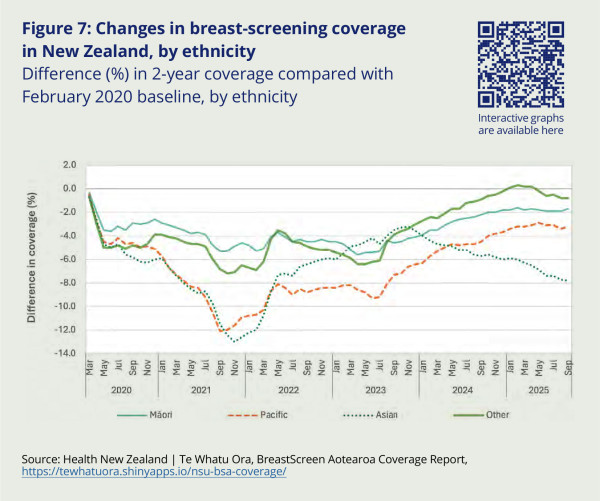
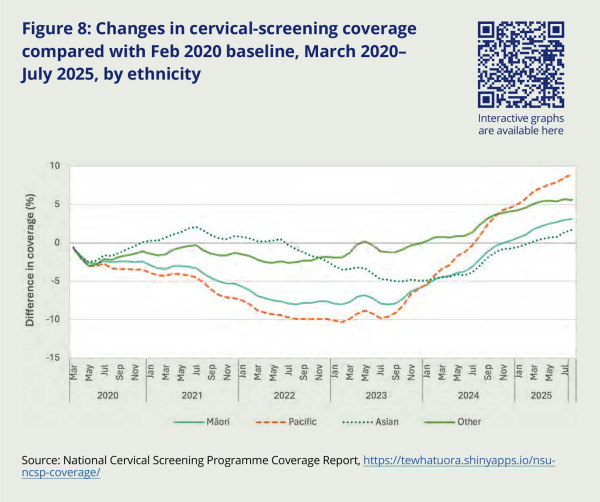
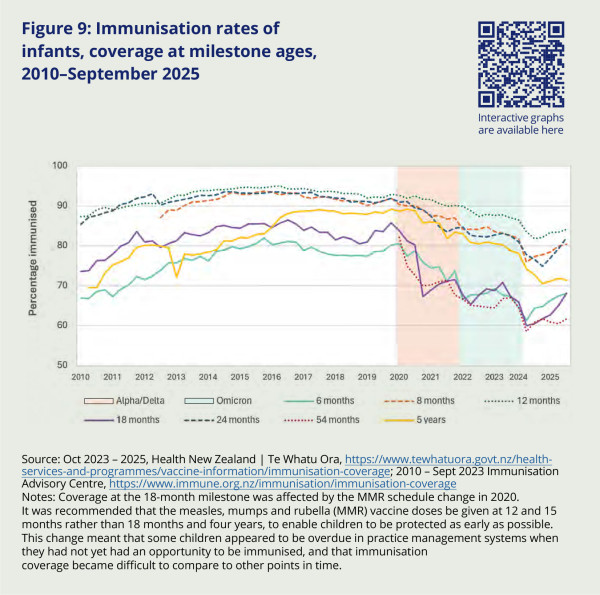
The disruption of some public services during the pandemic had longer-lasting effects. For example, the need to close many public health services during outbreaks of COVID-19 led to interruptions in key preventative programmes, such as childhood immunisation and cancer screening. For some of these programmes, coverage levels (the quantity and demographics of the people they are intended to target) have either only just recovered, or remain below, pre-pandemic levels.
Coverage levels of these preventative programmes, and the extent to which they have recovered, also differ by ethnicity. For breast screening services, coverage fell the most for women of Pacific and Asian ethnicity and had not returned to February 2020 levels by September 2025 (as seen in Figure 7 below).
Cervical screening coverage rates similarly fell after the first national lockdown in 2020, with Māori and Pacific women experiencing the steepest declines. However, coverage rebounded more quickly, with all ethnicities back to February 2020 levels by early 2025 (as seen in Figure 8 below).
Childhood immunisation rates also fell in the course of the pandemic and currently remain below 2020 levels, although there are recent signs of improvement.
Finally, school attendance fell during the pandemic from 58 percent in Term 2 of 2019 1185 to 40 percent in Term 2 of 2022.1186 The Education Review Office reported in 2025 that attendance had since recovered to pre-COVID-19 levels. 1187 However, this still left several years in which children completed less learning than they otherwise would have.
While service disruption may be inevitable during a pandemic, it is possible to mitigate some impacts through planning, agility and new approaches. As Phase One discussed, during the COVID-19 pandemic, the Cancer Control Agency worked with specialty working groups to develop guidelines supporting hospitals to safely maintain cancer-related care. The health system also employed innovations in service delivery which allowed many patients to continue to receive cancer care. There were positive equity trends in the provision of some services, and increased rates of diagnostic procedures for Māori.1188 Another example of innovation in service delivery was the introduction by Te Whatu Ora of self-testing options for cervical cancer in July 2023, which was one factor behind the recovery of cervical screening coverage rates.
L4.4 Trust and social cohesion came under increasing pressure as the pandemic progressed
I kaha ake te pēhitanga ki te whakawhirinaki me te kotahitanga i te whanaketanga o te mate urutā
New Zealand went into the COVID-19 pandemic with reserves of trust that were deep and long-established. Ranked against other OECD (Organisation for Economic Co-operation and Development) member countries, New Zealand's trust levels in public institutions were consistently high and – in the two decades before the pandemic – people's trust in government remained relatively stable even as it fell in other comparable countries, including Australia, the United States and Ireland.1189
New Zealand's pre-existing stocks of trust reaped dividends during the early pandemic response. As Phase One found, this provided a solid base that supported high initial compliance with lockdowns and other measures.1190 This was confirmed by a former Minister who told us that higher-than-anticipated levels of compliance with public health measures were what made it possible to eliminate COVID-19 from New Zealand in 2020.1191
Such early successes boosted trust levels further. In a survey undertaken in mid-2020, about 78 percent of respondents agreed that the management of the pandemic had increased their trust in government. 1192 Trust reached a historic peak at the end of 2020; there was still widespread compliance with public health measures and some consensus that the approach government was taking matched the level of risk and uncertainty the country faced. 1193 In the first half of 2021, New Zealanders were found to have one of the most favourable views of their country's COVID-19 response in the world, far exceeding public perceptions in countries that had experienced higher rates of mortality (such as Sweden, the United Kingdom and Canada). 1194
However, adherence to lockdown restrictions began to wane in late 2021 (see Chapter 2.4.3.2). A number of factors contributed. As more of the population was vaccinated – and particularly after the arrival of the Omicron variant, which was milder but more transmissible than Delta – some people increasingly questioned whether some restrictions were still proportionate to the risks. The evolution of the virus and the rapidly changing public health settings were destabilising and confusing for some, despite efforts by officials, providers and community leaders to explain what was required or why settings were changing. Public health messaging became more complex as the virus evolved, new tools emerged and the goal of the response shifted away from elimination. 1195
Declining levels of trust and social cohesion cannot be solely attributed to COVID-19 (or the response). Other issues undoubtedly contributed, and it is challenging to distinguish and measure their impacts from those of the pandemic, especially as it recedes from recent memory. This was evident in the results of a survey conducted in 2022, soon after most pandemic measures were relaxed. While most respondents agreed the COVID-19 response had been divisive, they also considered it 'well-judged and appropriate' and less divisive than other issues (namely, the distribution of wealth across society and access to housing).1196 When people express mistrust or distrust in government, it is not necessarily an immediate response to a particular decision: such sentiments may be long-standing and ingrained. 1197
Nonetheless, it is beyond argument that, for a section of New Zealand society, the experience of COVID-19 badly damaged their trust in government. The impact on social cohesion was perhaps most starkly demonstrated by the 23-day occupation of Parliament grounds by various protest groups. In many of our own engagements and submissions, people described losing trust in government due to some of the key decisions made in 2021–2022, such as the introduction of mandatory vaccination requirements.
L4.4.1 Why trust and social cohesion matter
He Take Nui te Whakawhirinaki me te Kotahitanga ā-Pāpori
'Trust' and 'social cohesion' may be abstract concepts, but they have very tangible social and political consequences and are mutually reinforcing. Countries with higher interpersonal trust are known to have lower levels of conflict and greater social cohesion, factors which in turn support trust in government.1198 Citizens who are trusting are also more likely to cooperate with each other to tackle complex problems in the interests of all: trust has been called 'a shared resource that enables networks of people to do collectively what individual actors cannot'. 1199
Importantly, trust is reciprocal. As the Organisation for Economic Co-operation and Development puts it, 'people need to feel trusted by the government in order to trust it. 1200 Trust also goes hand in hand with social cohesion: the state that arises when people work in unity towards a shared goal. 1201 This depends in part on tolerance for difference in all its forms, including different values, beliefs and attitudes to risk.
In combination, trust and social cohesion confer the social licence that governments need to govern and maintain legitimacy. In a pandemic, they are prime enablers of an effective response. However, trust and social cohesion can also quickly become casualties in a pandemic, sustaining damage 'that – at [its] most extreme – threaten[s] the rule of law, public safety and provision of essential services. 1202 In other words, trust and social cohesion are hard-won and, unless decision-makers fully assess the potential impacts of proposed response measures, they can be easily lost.
It is widely recognised that levels of trust in government play an important role in determining pandemic outcomes. One study found that, hypothetically, if all countries had the enjoyed the same high level of trust as Denmark, global infections could have been 12.9 percent lower (based on their trust in government) and 40.3 percent lower (based on levels of interpersonal trust). 1203
L4.4.2 Proliferating information sources created challenges
I hua ake he wero i te nui haere o ngā puna pārongo
As the Phase One report observed, the COVID-19 pandemic prompted the growth of misinformation (the unintended spread of false information) and disinformation (the deliberate spread of false information, sometimes by state actors, for a particular aim). 1204
In New Zealand, as elsewhere, this affected several areas of the response, particularly the vaccination campaign. The distribution of anti-COVID-19 vaccination content – often focused on safety issues – spiked during the vaccine rollout (see Box 8 below).1205 The 2021 lockdowns were another focus of misinformation and disinformation, with a variety of conspiracy theories and anti-government narratives gaining traction. 1206
| Box 8: Vaccine hesitancy | ||
|---|---|---|
|
Vaccine hesitancy – people being reluctant or refusing to be vaccinated1207 – takes many forms. Being vaccine hesitant is not the same as being anti-vaccination. Some people are willing to receive certain kinds of vaccines but not others, some may initially delay being vaccinated but then go ahead.1208 Some level of vaccine hesitancy will always exist, as it has since the first vaccines were developed.1209 Shortly before the COVID-19 vaccine became widely available, the Health Research Council of New Zealand estimated the proportion of vaccine-hesitant people varied between 5 and 20 percent of the population, with 2–4 percent 'highly suspicious of vaccinations, and … unlikely to change their minds.1210 Vaccination decisions reflect people's individual makeup, beliefs, perceptions and risk tolerance: all factors beyond the control of governments.1211 But there are many other systemic drivers of vaccination decisions – such as access to healthcare and previous experiences in the health system, access to reliable public health and medical information, and trust in government – that lie firmly within the orbit of the state. Before the widespread rollout of COVID-19 vaccines began in 2021, 31 percent of New Zealanders who reported having very little or no trust in government said they were somewhat or very unlikely to get the vaccine. This compared to just 7 percent hesitancy among those with the highest levels of trust in government.1212 For some, the novelty and rapid development of the Pfizer Comirnaty vaccine was a reason to mistrust its safety.1213 Large numbers of New Zealanders took up the opportunity to get vaccinated against COVID-19, with 90 percent of the eligible population having received two doses by mid-December 2021. However, certain groups were less likely to be vaccinated against COVID-19 during the pandemic: they included younger people, people living in poorer areas, and those with less positive attitudes towards their general practitioners, the Government, police and science.1214 Misinformation and disinformation had tangible impacts on the level of vaccine uptake during the pandemic. Global studies found that 'misinformation negatively affects people's self-reported compliance with public health guidance about COVID-19, as well as people's willingness to get vaccinated against the virus.1215 One study found misinformation had 'induced a decline in intent [to be vaccinated] of 6.2% in the UK and 6.4% in the USA among those who previously intended to take the vaccine.1216 It is likely similar trends occurred in New Zealand.1217 Individuals' vaccination decisions can have consequences, sometimes severe, for the population as a whole. For example, a single person infected with measles is likely to pass the virus on to another 12–18 people who have not already had measles or been immunised against the disease (which is why a high 95 percent coverage rate is needed to prevent the spread of this highly contagious disease).1218 As noted above (section L4.3.2), Health New Zealand | Te Whatu Ora data for 2024–2025 shows that the uptake of childhood vaccines at 18 months old (against illnesses such as whooping cough, diptheria, polio and measles) has decreased by approximately 10 percent since 2019, and the decline is greater for some regions and ethnicities.1219 |
||
L4.5 What we think is needed
Ā mātou whakaaro mō ngā mea e hiahiatia ana
L4.5.1 A dedicated programme identifying impacts on public service delivery and effectiveness, and appropriate responses
He hōtaka motuhake hei tautuhi i ngā pānga ki te tuku ratonga tūmatanui me tōna whaihua, me ngā urupare tika
New Zealanders depend on the timely and predictable supply of quality public services for many essential aspects of life and wellbeing – such as education, income support for people out of work or facing other challenges, personal care for the elderly or people with disabilities, and health care that prevents and responds to illnesses.
During pandemics, decision-makers and advisors need to make difficult trade-offs between protecting public health and ensuring continuity of services. However, consequences may be less severe if steps can be taken more promptly, during or after the pandemic, to mitigate any harmful effects of service disruptions.
Despite the many uncertainties surrounding the specific social impacts arising in another pandemic, government should put in place plans and systems that will:
-
- ensure health, social and education services can continue during a pandemic (even if at a reduced level when risk levels are especially high), whatever the circumstances. Phase One made useful recommendations about how this might be achieved.1221
- enable services to return to their pre-pandemic state as quickly as possible once the acute phase is over, and
- enable health, social and educational outcomes that have worsened during the pandemic to recover as soon as possible.
In order to achieve the second and third points above, government agencies need to assess and monitor COVID-19's ongoing impacts on the health, education and social sectors. In particular, they should build a clear understanding of:
-
- how quickly services were able to return to pre-pandemic delivery levels after COVID-19
- the factors that made it possible for some services to rapidly return to normal. What characteristics allowed this to happen – for example, particular contracting models, sectoral attributes, types of interventions – and how can they be replicated in a future pandemic, perhaps in other sectors?
- the factors and characteristics of services that took longer to recover after COVID-19. How could they be identified and overcome ahead of another pandemic?
- the key health, social and educational outcomes that deteriorated during COVID-19 – some of which may not yet have fully emerged. Have some key socioeconomic trends improved or worsened? Have those impacts resolved over time or are they more intractable? What more could be done, or done differently, to ensure that they do not worsen in another pandemic? Should that happen, despite best efforts, insight is also needed into the conditions or actions that would enable services to recover quickly to pre-pandemic levels.
In making these kinds of assessments, agencies should consider a wide spectrum of possible interventions. In some cases, restoring previous service levels might be enough to achieve pre-pandemic outcomes. In others, additional interventions – such as more support, information or targeted programmes to improve access – might be needed. For example, carefully-targeted public health information by trusted sources could be necessary to reverse falling immunisation rates or targeted intensive tuition may be required to close learning gaps.
This work of assessing the impacts of COVID-19 on service levels, and identifying the best means of responding to service levels or outcomes that remain below pre-pandemic levels, should be a priority for agencies, with clear deadlines set by Ministers and an expectation that the results will be published, to inform future advisors and decision-makers.
L4.5.2 A measured and transparent approach to communicating science and response decisions
He huarahi tōtika, pūataata hoki ki te whakawhiti
kōrero pūtaiao me ngā whakatau urupare
The extent to which public trust and social cohesion have declined worldwide since COVID-19 has significant consequences for New Zealand's preparedness for future pandemics. The substantial reserves of trust and cohesion that helped us weather the early months of the pandemic have declined such that, as the Phase One report found, New Zealand 'would start from a different place if another pandemic broke out next week'.1222
Usually, it is in the ordinary, day-to-day interactions between people and the government that trust is either built or damaged, with knock-on effects for social cohesion.1223 During COVID-19, the provision and understanding of information, which was often complex and competing, became one of the key testing grounds for social cohesion and trust. Going into a future pandemic, information – often complex and competing – and coexistence of proven factual information alongside misinformation and disinformation will be part of the reality. We consider it is important that governments should plan for this future information landscape and consider how communications could be improved in this environment to foster trust and the buy-in needed for a successful pandemic response.
Our focus here has been primarily on the question of what governments in a democracy can or should do to deal with competing information flows in a pandemic. The topics of 'misinformation' and 'disinformation' came up repeatedly in interviews and engagements we held, and in submissions we received. These discussions and submissions covered a range of perspectives. Some stated that misinformation and disinformation contributed to unnecessary deaths during the COVID-19 pandemic and that concerted efforts were needed to counter these forces.1224
Others expressed concern about an intolerance of dissenting views during the pandemic, with alternative opinions often being labelled as 'disinformation' or 'misinformation'.
I'm pro vaccine and lockdowns and the general response, but very worried when people aren't allowed to speak to put the other side of the vaccine and lockdowns.
45-54-year-old Māori/Pākehā female, Waikato1225
Those who questioned the prevailing narrative were frequently labelled as anti-science or conspiracy theorists, discouraging open dialogue.
25-34-year-old Pākehā male, Wellington1226
This divergence of views highlights the challenge that governments face. On the one hand, an effective response relies on people cooperating with and getting behind public health measures to reduce transmission and protect lives. On the other, the public retain their right to 'seek, receive, and impart information and opinions of any kind in any form'1227 and many people in a democracy are understandably suspicious of efforts by authorities to steer debate.
The challenge is further compounded by the nature of decisions that must be taken during a pandemic and the evolving nature of scientific information. First, as is evident in our assessment of the vaccine mandates (chapter 2.2) and lockdowns (chapter 2.4), decisions about public health measures can involve difficult trade-offs between competing values and objectives. Some of these decisions may have to be made quickly, involve life-and-death consequences and irrevocably close off future options. People will inevitably disagree about the merits of those judgements.
Second, particularly in the early days of a pandemic, the information upon which public health measures and advice are based can be limited and changing. One example from the COVID-19 pandemic was early advice on the use of facemasks. As Phase One described, advice in April and June 2020 from the World Health Organization on facemasks was focused on their use by health workers.1228 At this point, the Organization had not yet recognised that the virus was spread by airborne particles.1229 Once the transmission mechanism became clear, the New Zealand Government began to require the use of facemasks in some settings from August 2020. The evolving nature of scientific knowledge is especially difficult in the early stage of the pandemic, where the public is likely to desire certainty and clarity in public health advice.
Given these issues, we consider that the best approach to managing proliferating information flows in future is for the government to be as measured and transparent as possible in its own communications. This has a number of implications:
-
- In designing their responses and setting specific public health measures, the government should be guided by the best scientific evidence available at the time.
- The government should be open and clear about where it is obtaining information from, so that others can review that material and the conclusions the government is drawing from it.
- The government should communicate the details of the information it has used and how it has reached its decisions.
- The government should be transparent about the science and evidence it is using (including its limitations), and acknowledge that knowledge may shift.
The final point is particularly important for trust. As the International Science Council observed about the global response to the pandemic,
…at the start of the pandemic important and urgent decisions had to be made based on very limited information and data, and in the face of much uncertainty. With only very crude models and incomplete knowledge, decision-makers claimed to be "following the science", but this phrase was frequently misused. Both they and the science community needed to be clear about what was known and not known, the uncertainties that existed and that the initial strategies were provisional, and that responses would need to evolve as knowledge improved.1230
The approach outlined above is not a silver bullet. Even with more transparency about the basis of decisions and the limitations of science, there will be resistance to aspects of future pandemic responses and disagreement about evidence and its implications. Nor should this approach be read as a criticism of the New Zealand Government's response during the COVID-19 pandemic. Throughout the pandemic response, senior officials and decision-makers sought to communicate openly, clearly and on the basis of the evidence available to them. The success of public communications in the first stages of the pandemic, and the overall pandemic outcome in terms of mortality, are a testament to these efforts.1231
L4.5.3 Ongoing monitoring of evidence about trust and social cohesion
Te aroturuki tonutanga i ngā taunakitanga mō te whakawhirinaki me te kotahitanga ā-pāpori
The drivers of, and solutions to, declining public trust and social cohesion are complex. Many factors are involved, such as social isolation, technological change, inequalities, economic insecurity and perceptions of fairness. 1232 We note the large amount of research and policy work underway here and internationally to better understand these factors and rebuild public trust in the wake of the COVID-19 pandemic. These efforts include (but are not limited to) strategies to counter isolation and loneliness, policies for managing new technologies, and digital and media literacy programmes.1233 Because trust and social cohesion are so central to effective pandemic responses, it would be prudent for the Government to pay close attention to this research and policy work, to ensure that New Zealand can learn and apply any relevant lessons.
Having a stronger evidence base about local patterns and trends in trust and social cohesion in New Zealand would also be beneficial. Several recent New Zealand initiatives have sought to measure dimensions such as a sense of belonging, inclusion, participation, recognition (of our own language, for example) and legitimacy (namely, confidence in key societal institutions).1234 Such tools can help decision-makers identify and address areas of vulnerability.1235 There are also similar initiatives to measure dimensions of social cohesion in countries around the world, including in Australia and the United Kingdom.1236
L4.6 Recommendations | Ngā tūtohutanga
Recommendation 4A:
Research the impact of the COVID-19 response
The Ministers of Education and Health, and the Ministers for Social Development and Employment and Disability Issues should, as a matter of priority, direct their agencies to carry out, publish and share with each other research into:
- how quickly their services were able to return to pre-pandemic delivery levels after COVID-19
- other factors that made it possible for some services to rapidly return
to normal - the factors and characteristics of services that took longer to recover after COVID-19
- the key health, social and educational outcomes that deteriorated during COVID-19 – some of which may not yet have fully emerged
- what interventions would most cost-effectively restore service coverage levels or outcomes.
Recommendation 4B:
Ensure good transparency and communication of decisions in a pandemic
Governments facing a pandemic should:
-
- be guided by the best scientific evidence available at the time, in designing their responses and setting specific public health measures
- be open and clear about the science and evidence they are using (including its limitations), and that knowledge may change and develop over time
- be open and clear about where they are obtaining their information from, and how they have reached decisions, so others can review that material and the conclusions the government is drawing from it.
The Government should task an agency with responsibility for monitoring local and international research and policy into initiatives that increase trust and social cohesion, and for advising on lessons and policy options for New Zealand.
The agency with responsibility for monitoring local and international research and policy should develop a clear evidence base about patterns and trends in trust and social cohesion in New Zealand. (See Recommendation 4C above.)
1175 The National Emergency Management Agency defines these four steps as: - Risk reduction: identifying and analysing long-term risks to human life and property from hazards; taking steps to eliminate these risks if practicable, and, if not, reducing the magnitude of their impact and the likelihood of their occurring. - Readiness: developing operational systems and capabilities before an emergency happens including self-help and response programmes for the general public, and specific programmes for emergency services, lifeline utilities, and other agencies. - Response: actions taken immediately before, during, or directly after an emergency to save lives and protect property, and to help communities recover. - Recovery: the coordinated efforts and processes used to bring about the short, medium, and long term holistic regeneration and enhancement of a community following an emergency.
National Emergency Management Agency, 'About emergency management' (last updated 28 November 2025), https://www.civildefence.govt.nz/about/about-emergency-management
1176 Royal Commission of Inquiry (COVID-19 Lessons) Amendment Order (No 2) 2024, Schedule 2, cl 4(3), https://legislation.govt.nz/regulation/public/2022/0323/latest/LMS792965.html
1177 NZ Royal Commission of Inquiry into COVID-19 Lessons Learned: Phase One, Main Report (2024), Part 2, section 6.5.1, https://www.covid19lessons.royalcommission.nz/reports-lessons-learned/mainreport/part-two/6-5-our-assessment-social-sector-impacts-and-responses
1178 The Independent Panel for Pandemic Preparedness and Response, COVID-19: Make it the Last Pandemic (Geneva: 2021), https://recommendations.theindependentpanel.org/main-report/, p 39
1179 Anna Adamecz-Volgyi and Agnes Szabo-Morvai, 'Confidence in Public Institutions is Critical in Containing the COVID-19 Pandemic', World Medical and Health Policy Vol 15:4 (2023), https://doi.org/10.1002/wmh3.568, p 553
1180 Thomas J. Bollyky and others, 'Pandemic preparedness and COVID-19: an exploratory analysis of infection and fatality rates, and contextual factors associated with preparedness in 177 countries, from Jan 1, 2020, to Sept 30, 2021', The Lancet Vol 399:10334 (16 April 2022), https://doi.org/10.1016/S0140-6736(22)00172-6, pp 1489–1512
1181 NZ Royal Commission of Inquiry into COVID-19 Lessons Learned: Phase Two, analysis of Stats NZ’s
Integrated Data Infrastructure and Longitudinal Business Database
1182 NZCER, analysis for the NZ Royal Commission of Inquiry into COVID-19 Lessons Learned: Phase Two (2026)
1182 NZCER, analysis for the NZ Royal Commission of Inquiry into COVID-19 Lessons Learned: Phase Two (2026)
1183 Andrew Webber, Student learning during COVID-19: Literacy and Maths in Years 4–10 updated to 2022,
Ministry of Education (2023), https://www.educationcounts.govt.nz/__data/assets/pdf_file/0020/221609/
Update-July-2023.pdf
1184 Andrew Webber, Student learning during COVID-19: Literacy and maths in years 4–10, He Whakaaro:
Education Insights, Ministry of Education (2021), https://www.educationcounts.govt.nz/__data/assets/
pdf_file/0004/208147/He-Whakaaro-Student-learning-during-COVID-19-Literacy-and-maths-in-Years-4-10.
pdf, pp 1, 13
1185 Andrew Webber, How COVID-19 is affecting school attendance, He Whakaaro: Education Insights, Ministry of Education (December 2020), https://www.educationcounts.govt.nz/__data/assets/pdf_file/0013/204610/How-COVID-19-is-affecting-school-attendance.pdf
1186 Education Review Office, Long Covid: Ongoing impacts of Covid-19 on schools and learning (June 2023), https://www.evidence.ero.govt.nz/media/enqez5t2/long-covid-ongoing-impacts-of-covid-19-on-schools-and-learning.pdf
1187 Education Review Office, Back to class: How are attitudes to attendance changing? (2025), https://www.evidence.ero.govt.nz/media/svzhs1uk/back-to-class-how-are-attitudes-to-attendance-changing-summary-report.pdf, p 2
1188 NZ Royal Commission of Inquiry into COVID-19 Lessons Learned: Phase One, Main Report (2024), Part 2 Section 5.5.3.3, https://www.covid19lessons.royalcommission.nz/reports-lessons-learned/main-report/part-two/5-5-what-happened
1189 Organisation for Economic Co-operation and Development, Drivers of Trust in Public Institutions in New Zealand, section 1.1 (Paris: 2023), https://doi.org/10.1787/948accf8-en
1190 NZ Royal Commission of Inquiry into COVID-19 Lessons Learned: Phase One, Main Report (2024), Part 2 Section 3.2, https://www.covid19lessons.royalcommission.nz/reports-lessons-learned/main-report/part-two/3-2-what-happened
1191 NZ Royal Commission of Inquiry into COVID-19 Lessons Learned: Phase Two, interview with Rt Hon. Chris Hipkins (4 August 2025)
1192 Shaun Goldfinch, Ross Taplin and Robin Gauld, 'Trust in government soars in Australia and New Zealand during pandemic', The Conversation (12 February 2021), https://theconversation.com/trust-in-government-soars-in-australia-and-new-zealand-during-pandemic-154948
1193 Public Service Commission, 'Rangahau o Kiwis Count | Kiwis Count', https://www.publicservice.govt.nz/research-and-data/kiwis-count
Shaun Goldfinch, Ross Taplin and Robin Gauld, 'Trust in government soars in Australia and New Zealand during pandemic', The Conversation (12 February 2021), https://theconversation.com/trust-in-government-soars-in-australia-and-new-zealand-during-pandemic-154948
Edelman, '2020 Edelman Trust Barometer Spring Update: Trust and the Coronavirus' (5 May 2020), https://www.edelman.com/research/trust-2020-spring-update
1194 Kat Devlin, Moira Fagan and Aidan Connaughton, 'People in Advanced Economies Say their Society is More Divided Than Before Pandemic', Pew Research Centre (23 June 2021), https://www.pewresearch.org/global/2021/06/23/people-in-advanced-economies-say-their-society-is-more-divided-than-before-pandemic/
1195 The COVID-19 Independent Continuous Review, Improvement and Advice Group, Lessons from the Response to Omicron to Inform the Future (20 May 2022), https://www.dpmc.govt.nz/sites/default/files/2023-01/Lessons-from-the-Response-to-Omicron-to-Inform-the-Future-Letter-from-the-COVID-19-Independent-Continuous-Review-Improvement-and-Advice-Group.pdf, pp 10–11
1196 Julia Gabel and Chris Knox, 'Divided NZ? Exclusive poll reveals how divided we feel – and what we agree on', NZ Herald (2 December 2022), https://www.nzherald.co.nz/nz/divided-nz-exclusive-poll-reveals-how-divided-we-feel-and-what-we-agree-on/UUZISO7IZFCF5DAG5G77E7MHGU/
1197 The term 'mistrust' is usually used to suggest generalised feelings of suspicion, fear and/or scepticism whereas 'distrust' refers to feelings of suspicion, fear and/or scepticism that derive from actual experience. Derek M. Griffith and others, 'Using Mistrust, Distrust, and Low Trust Precisely in Medical Care and Medical Research Advances Health Equity', American Journal of Preventive Medicine Vol 60:3 (2021), https://doi.org/10.1016/j.amepre.2020.08.019, pp 442–445
1198 Kenneth Newtown, Dietland Stolle and Sonja Zmerli, 'Social and Political Trust', in Eric M. Uslaner (ed), The Oxford Handbook of Social and Political Trust (New York: 2018), https://api.pageplace.de/preview/DT0400.9780190274818_A35486584/preview-9780190274818_A35486584.pdf
1199 Thomas J. Bollyky and others, 'Pandemic preparedness and COVID-19: an exploratory analysis of infection and fatality rates, and contextual factors associated with preparedness in 177 countries, from Jan 1, 2020, to Sept 30, 2021', The Lancet Vol 399:10334 (16 April 2022), https://doi.org/10.1016/S0140-6736(22)00172-6, pp 1489–1512
1200 Organisation for Economic Co-operation and Development, Drivers of Trust in Public Institutions in New Zealand, section 4.1 (Paris: 2023), https://doi.org/10.1787/948accf8-en
1201 NZ Royal Commission of Inquiry into COVID-19 Lessons Learned: Phase One, Main Report (2024), Glossary, https://www.covid19lessons.royalcommission.nz/reports-lessons-learned/main-report/appendices/glossary
1202 NZ Royal Commission of Inquiry into COVID-19 Lessons Learned: Phase One, Main Report (2024), Part 2 Section 8.6.2, https://www.covid19lessons.royalcommission.nz/reports-lessons-learned/main-report/part-two/8-6-controversy-over-compulsory-measures
1203 Thomas J. Bollyky and others, 'Pandemic preparedness and COVID-19: an exploratory analysis of infection and fatality rates, and contextual factors associated with preparedness in 177 countries, from Jan 1, 2020, to Sept 30, 2021', The Lancet Vol 399:10334 (16 April 2022), https://doi.org/10.1016/S0140-6736(22)00172-6, pp 1489–1512
1204 NZ Royal Commission of Inquiry into COVID-19 Lessons Learned: Phase One, Main Report (2024), Part 3 Section 10.2, https://www.covid19lessons.royalcommission.nz/reports-lessons-learned/main-report/part-three-moving-forward/10-2-the-context-for-our-lessons-for-the-future
1205 Kantar Public, Unite Against the COVID-19 Infodemic: Research Report (September 2022), https://www.dpmc.govt.nz/sites/default/files/2023-06/proactive-release-covid-19-infodemic-sep22-kantar.pdf, p 11
1206 Logically, Misinformation, disinformation and malinformation threats impacting New Zealand audiences: A critical analysis of the New Zealand Information Environment (20 October 2023), https://logically-web.cdn.prismic.io/logically-web/ZyDdoK8jQArTz9ly_logically-report-misinformation-disinformation-and-malinformation-threats-impacting-new-zealand-audiences-may-2024.pdf, pp 4 and 39
Kantar Public, Unite Against the COVID-19 Infodemic: Research Report (September 2022), https://www.dpmc.govt.nz/sites/default/files/2023-06/proactive-release-covid-19-infodemic-sep22-kantar.pdf
1207 World Health Organization, 'Ten threats to global health in 2019', https://www.who.int/news-room/spotlight/ten-threats-to-global-health-in-2019
1208 Health Research Council of New Zealand, 'New tool to tackle vaccine hesitancy in NZ' (27 July 2021), https://www.hrc.govt.nz/news-and-events/new-tool-tackle-vaccine-hesitancy-nz
1209 World Health Organization, 'Vaccination and trust: How concerns arise and the role of communication in mitigating crises' (14 March 2017), https://www.who.int/publications/i/item/vaccination-and-trust, p 19
1210 Health Research Council of New Zealand, 'New tool to tackle vaccine hesitancy in NZ' (27 July 2021), https://www.hrc.govt.nz/news-and-events/new-tool-tackle-vaccine-hesitancy-nz
1211 Matthew J. Hornsey, Emily A Harris and Kelly S. Fielding, 'The Psychological Roots of Anti-Vaccination Attitudes: A 24-Nation Investigation', Health Psychology Vol 37:4 (2018), https://psycnet.apa.org/doi/10.1037/hea0000586 and https://www.apa.org/pubs/journals/releases/hea-hea0000586.pdf
1212 Kate C. Prickett and Simon Chapple, 'Trust in Government and Covid-19 Vaccine Hesitancy', Policy Quarterly, Vol 17:3 (2021), https://doi.org/10.26686/pq.v17i3.7135
1213 Verian, 'Life since the pandemic: How the COVID-19 pandemic experience has shaped public health attitudes and beliefs on public health, infectious disease and vaccination' (November 2023), https://www.health.govt.nz/system/files/2024-05/life-since-the-pandemic-how-covid-19-pandemic-experience-shaped-public-attitudes-beliefs-16mar24.pdf
1214 Mathew D. Marques and others, 'Psychological predictors of COVID-19 vaccination in New Zealand', New Zealand Journal of Psychology Vol 51:1 (2022), https://doi.org/10.26181/19919119, pp 10–27
Kate C. Prickett, Hanna Habibi and Polly Atatoa Carr, 'COVID-19 Vaccine Hesitancy and Acceptance in a Cohort of Diverse New Zealanders', The Lancet Regional Health – Western Pacific Vol 14 (September 2021), https://doi.org/10.1016/j.lanwpc.2021.100241
Thomas Rozbroj and Kristen McCaffery, 'The importance of addressing social inequalities and targeting the undecided to promote vaccination against COVID-19', The Lancet Regional Health – Western Pacific, Vol 14 (2021), https://doi.org/10.1016/j.lanwpc.2021.100250
1215 Jon Roozenbeek, Claudia R. Schneider, Sarah Dryhurst, John Kerr, Alexandra L. J. Freeman, Gabriel Recchia, Anne Marthe van der Bles and Sander van der Linden; 'Susceptibility to misinformation about COVID-19 around the world', R Soc Open Sci Vol 7 (Issue 10): 201199 (1 October 2020), https://doi.org/10.1098/rsos.201199
1216 S. Loomba, A. de Figueiredo, S.J. Piatek and others, 'Measuring the impact of COVID-19 vaccine misinformation on vaccination intent in the UK and USA', Nat Hum Behav 5, 337–348 (2021), https://doi.org/10.1038/s41562-021-01056-1
1217 Kate C. Prickett and Simon Chapple, Trust in Government and Covid-19 Vaccine Hesitancy, Policy Quarterly Vol. 17 No. 3 (2021) Special Issue: Just Transitions, https://doi.org/10.26686/pq.v17i3.7135
1218 Immunisation Advisory Centre, 'Measles' (last updated 19 November 2025), https://www.immune.org.nz/diseases/measles
1219 Health New Zealand | Te Whatu Ora, 'Immunisation coverage – National and regional data immunisation data in detail' (last updated 5 November 2025), https://www.tewhatuora.govt.nz/for-health-professionals/vaccine-information/immunisation-coverage
1220 Verian, Measuring public health behaviours and intentions (12 July 2024), https://www.health.govt.nz/system/files/2024-07/Measuring-public-health-behaviours-and-intentions-jul24.pdf, p 36
1221 NZ Royal Commission of Inquiry into COVID-19 Lessons Learned: Phase One, Main Report (2024), Part 3 Section 11.4, https://www.covid19lessons.royalcommission.nz/reports-lessons-learned/main-report/part-three-moving-forward/11-4-complete-table-of-recommendations. See recommendations 22, 23, 30, 31, 32, 33, 34, 35
1222 NZ Royal Commission of Inquiry into COVID-19 Lessons Learned: Phase One, Main Report (2024), Part 2 Section 8.1, https://www.covid19lessons.royalcommission.nz/reports-lessons-learned/main-report/part-two/8-1-mandatory-measures-introduction
1223 Organisation for Economic Co-operation and Development, Drivers of Trust in Public Institutions in New Zealand, section 1.1 (Paris: 2023), https://doi.org/10.1787/948accf8-en
UMR Research, Understanding the Drivers of Satisfaction and Trust in Public Services – A Qualitative Study for State Services Commission (December 2008), https://www.publicservice.govt.nz/assets/DirectoryFile/Understanding-the-Drivers-of-Satisfaction-and-Trust-in-Public-Services-a-qualitative-study.pdf
1224 NZ Royal Commission of Inquiry into COVID-19 Lessons Learned: Phase Two, engagement with misinformation and disinformation experts (17 April 2025)
NZ Royal Commission of Inquiry into COVID-19 Lessons Learned: Phase Two (2026), Pandemic Perspectives, https://www.covid19lessons.royalcommission.nz/reports-lessons-learned/phase-two/pandemic-perspectives, p 233
1225 NZ Royal Commission of Inquiry into COVID-19 Lessons Learned: Phase Two (2026), Pandemic
Perspectives, https://www.covid19lessons.royalcommission.nz/reports-lessons-learned/phase-two/
pandemic-perspectives, p 227
1226 NZ Royal Commission of Inquiry into COVID-19 Lessons Learned: Phase Two (2026), Pandemic
Perspectives, https://www.covid19lessons.royalcommission.nz/reports-lessons-learned/phase-two/
pandemic-perspectives, p 231
1227 New Zealand Bill of Rights Act 1990, s 14, https://www.legislation.govt.nz/act/public/1990/0109/latest/whole.html#DLM225513
1228 NZ Royal Commission of Inquiry into COVID-19 Lessons Learned: Phase One, Main Report (2024), Part 2 Section 5.3.2.4, https://www.covid19lessons.royalcommission.nz/reports-lessons-learned/main-report/part-two/5-3-what-happened-public-health
1229 NZ Royal Commission of Inquiry into COVID-19 Lessons Learned: Phase One, Main Report (2024), Part 2 Section 5.3.2.4, https://www.covid19lessons.royalcommission.nz/reports-lessons-learned/main-report/part-two/5-3-what-happened-public-health
1230 International Science Council, 'Unprecedented & Unfinished: Policy Lessons and Recommendations from COVID-19 – 2nd editions' (Paris: 2023), https://council.science/wp-content/uploads/2025/06/UnprecedentedAndUnfinished-2ndEdition-2023_N.pdf, p 30
1231 NZ Royal Commission of Inquiry into COVID-19 Lessons Learned: Phase One, Main Report (2024), Part 2 Section 2.7, https://www.covid19lessons.royalcommission.nz/reports-lessons-learned/main-report/part-two/2-7-what-we-learned-looking-back
1232 Sir Peter Gluckman, Dr Anne Bardsley, Professor Paul Spoonley, Dr Charles Royal, Noami Simon-Kumar and Dr Andrew Chen, 'Sustaining Aotearoa New Zealand as a Cohesive Society', Koi Tū: the Centre for Informed Futures (2021), https://informedfutures.org/wp-content/uploads/pdf/Sustaining-Aotearoa-New-Zealand-as-a-cohesive-society.pdf, p 14–15
1233 Department for Digital, Culture, Media and Sport, A Connected Society: A Strategy for Tackling Loneliness – Laying the Foundations for Change (2018), https://www.gov.uk/government/publications/a-connected-society-a-strategy-for-tackling-loneliness, p 7
Sir Peter Gluckman, Paul Spoonley, Anne Bardsley, Richie Poulton, Te Ahukaramū Charles Royal, Hema Sridhar and Dawnelle Clyne, 'Addressing the challenges to social cohesion', Koi Tū: The Centre for Informed Futures (2023), https://informedfutures.org/wp-content/uploads/pdf/Addressing-the-challenges-to-social-cohesion.pdf, p 13
Tara Cobham, 'Schools to Teach Children about Spotting Fake News Online in Curriculum Overhaul after UK Riots', The Independent (10 August 2024), https://www.independent.co.uk/news/uk/politics/schools-fake-news-social-media-uk-riots-government-b2594545.html
1234 The Health Clark Foundation, Social Cohesion in New Zealand (2025), https://www.helenclark.foundation/research/social-cohesion-in-new-zealand
Sir Peter Gluckman, Paul Spoonley, Anne Bardsley, Richie Poulton, Te Ahukaramū Charles Royal, Hema Sridhar and Dawnelle Clyne, 'Addressing the challenges to social cohesion', Koi Tū: The Centre for Informed Futures (2023), https://informedfutures.org/wp-content/uploads/pdf/Addressing-the-challenges-to-social-cohesion.pdf, p 13
Tara Cobham, 'Schools to Teach Children about Spotting Fake News Online in Curriculum Overhaul after UK Riots', The Independent (10 August 2024), https://www.independent.co.uk/news/uk/politics/schools-fake-news-social-media-uk-riots-government-b2594545.html
Ministry of Social Development, 'Te Korowai Whetū Social Cohesion Measurement' (2022), https://www.msd.govt.nz/about-msd-and-our-work/work-programmes/community/social-cohesion/te-korowai-whetu-social-cohesion-measurement.html
Craig Fookes, Social Cohesion in New Zealand: Background Paper to Te Tai Waiora: Wellbeing in Aotearoa New Zealand in 2022, The Treasury (24 November 2022), https://www.treasury.govt.nz/publications/ap/ap-22-01
Ashleigh Prakash, Social cohesion in Auckland: results from the Quality of Life Survey, technical report for Auckland Council (September 2023), https://www.knowledgeauckland.org.nz/publications/social-cohesion-in-auckland-results-from-the-quality-of-life-survey/
1235 NZ Royal Commission of Inquiry into COVID-19 Lessons Learned: Phase Two, engagement with Emeritus Professor Paul Spoonley (22 October 2025)
1236 Australian Institute of Health and Welfare, 'Social cohesion and social connection' (last updated 16 October 2025), https://www.aihw.gov.au/reports/australias-welfare/social-cohesion-and-social-connection
James O'Donnell, Qing Guan with Trish Prentice, 2024 Mapping Social Cohesion, Scanlon Foundation Research Institute (2024), https://scanloninstitute.org.au/wp-content/uploads/Mapping-Social-Cohesion-2024-Report.pdf
Dominic Abrams, Ben Davies and Zoe Horsham, Rapid Review: Measuring Social Cohesion, University of Kent (April 2023), https://assets.publishing.service.gov.uk/media/65fd7230f1d3a0001132adc4/Rapid_Review_Measuring_Social_Cohesion.pdf
More in Common, UCL Policy Lab and Citizens UK, This Place Matters: A social connection map of Britain (3 August 2025), https://www.moreincommon.org.uk/latest-insights/this-place-matters-a-social-connection-map-of-britain/