

3.1 Lesson One: Systems that promote good government decision-making Akoranga Tuatahi: Ngā pūnaha e whakatairanga ana i te whakatau tika a te kāwanatanga

Lesson One: Systems that promote good government decision-making
Akoranga Tuatahi: Ngā pūnaha e
whakatairanga ana i te whakatau tika a te kāwanatanga
L1.1 Lesson One in brief
Akoranga Tuatahi – Te kōrero poto
Government should focus on ensuring strong standing strategic capability in the centre of government, and on using that capability well.
On the whole, decisions made during the pandemic response were balanced and reasonable. However, some decisions were taken with less information than could have been available – for example, certain mandate decisions. Also, New Zealand's pandemic strategy and settings did not adapt early enough to respond to changing scenarios.
It would be beneficial for government to investigate a new strategic function to look at improving modelling capacity, strengthening estimates of public health measure impacts, improving the availability of real-time data and developing a framework for structuring advice to decision-makers.
High-quality, timely data and modelling are key to good decisions. Future decision makers should ensure that epidemiological modelling can be undertaken quickly in an emerging pandemic. They should also take steps ahead of a future pandemic to ensure that – at the point they need to decide whether, when and how to introduce public health measures – they have the real-time data, estimates of the impacts of those measures on economic and social outcomes, and frameworks for weighing the impacts.
Fostering and maintaining strong relationships between the government, business and community organisations will help support flexible and effective pandemic responses.
Several long-standing processes in the existing system (such as the requirement to produce regulatory impact statements and consult widely on Cabinet proposals) are designed to ensure considered, well-informed decisions. Exceptions to these processes in a future pandemic should be kept as narrow as possible. The Cabinet Manual should be updated to require that decisions taken outside of regular quality assurance processes are promptly reviewed.
Elimination strategies can be very beneficial in terms of preventing large numbers of deaths and hospitalisations from a severe pandemic. But they are difficult to exit. Governments should present such strategies from the outset of a pandemic as temporary measures and establish mechanisms that trigger prompt, regular and transparent strategic reviews. Taking these measures is likely to build trust in government and help plan for the exit from any elimination phase.
L1.2 What we learned from New Zealand's COVID-19 experience
Ngā mea i akona mai i te wheako o Aotearoa ki te KOWHEORI-19
The COVID-19 pandemic was one of the biggest shocks to hit New Zealand in living memory, requiring the large-scale mobilisation of resources and extraordinary uses of power. Despite the scale of the challenge faced, high levels of uncertainty at the outset and the very difficult decisions that had to be made, in most respects, New Zealand's system of official decision-making and planning held up well. In the first year of the pandemic response, a clear strategic direction was set, and decisions were made in accordance with that direction. The result was little loss of life and a broad restoration of 'normal life', particularly when compared with other countries.
As examined in Part 2 of this report, the decision-making system came under more pressure during the period which this phase of the Inquiry has focused on. Decision-making would have benefited from additional data and information as to the potential economic and social impacts of the choices before ministers and more regular, updated data on specific types of impacts (see Chapter 2.4, sections 2.4.7.3 and 2.4.7.4). In addition, it would have been desirable for there to be a clear or single record of the information that was brought to bear in relation to key decisions (Chapter 2.4, section 2.4.7.2).
Despite such weaknesses, the decision-making system generally performed well. On the whole, the decisions we reviewed were reasonable, balanced and well-informed. Ministers and officials sought advice from experts on technical matters throughout the response. Decisions that significantly affected the rights and freedoms of New Zealanders were appropriately taken by people who were accountable to the electorate. Several of these decisions were challenged, and upheld, in the courts. As one legal academic has commented, a striking characteristic of New Zealand's experience during the pandemic was that 'the operation of democratic government was preserved and processes holding the government to account for its action were maintained.'980
However, looking across the key decisions we have reviewed, we see four issues that can arise with decision-making in a pandemic. The first is that the overarching strategy and settings may not prepare and adapt early enough to respond to changes in variants or circumstances (see Chapter 2.4, sections 2.4.11.2 and 2.4.13). We heard from former ministers that they had in mind the need to transition out of the elimination strategy, especially once effective public health tools such as vaccination were available. Ministers and officials were also understandably concerned about the risks of new, more dangerous variants emerging, which vaccination might not have been sufficient to control. But as Phase One of the inquiry noted, over time, 'the elimination strategy increasingly came to be seen as an enduring goal, rather than a time-limited phase linked to achieving population-wide vaccination'.981
One result of this was that there was 'less emphasis on all-of-government, long-term, strategic planning – work that could test options and scenarios on how and when to adjust or move beyond elimination, what would replace the elimination goal, and that could integrate health and social, economic and wellbeing goals.'982 This meant that New Zealand's exit from the elimination strategy was difficult, rather than prepared and staged. Examples of this can be seen in the development and implementation of the COVID-19 Protection Framework during the Delta outbreak (see Chapter 2.4, section 2.4.10.3) and in New Zealand's slow approach to adopting alternative testing technologies (see Chapter 2.3, section 2.3.5.5).
The lack of a timely strategic refresh meant that the pandemic response appeared to many parties to be over-centralised and risk-averse. We heard from a range of people and groups that the Government missed some opportunities to harness the resources and innovative thinking of the community and business sectors – a view we discuss further in section 1.3 below.
A second issue with decision-making in the pandemic was that some decisions may be taken with less information than is desirable. One example was a few decisions around the occupational mandates (where advice on their potential labour market impacts was light, despite there being good research available on the effects of involuntary unemployment on incomes, future employment and wellbeing) (Chapter 2.2, section 2.2.6.2). A related issue is insufficient measurement and monitoring of some decisions, to make sure that they are having the desired effects. An example here is decisions about the vaccine passes and Vaccination Assessment Tool (where there was little structured monitoring of their specific effects – see Chapter 2.2, section 2.2.6.4).
Finally, while decision-makers in the COVID-19 pandemic made good use of frequent, detailed health advice on how public health measures would affect the transmission of the virus and rates of hospitalisations and death, the quality, coherence and timeliness of formal advice on economic, social and educational impacts did not in general match that of advice on health impacts. There are opportunities to enhance data and modelling on the social and economic impacts of public health measures in a future pandemic.
L1.3 What we think is needed: making better decisions and preparations for the future
Ā mātou whakaaro mō ngā mea e hiahiatia
ana: te whakapai ake i te whakatau me te whakarite mō anamata
L1.3.1 In an emergency, limit exceptions to regular decision-making processes as much as possible
I te wā ohotata, me whakaiti i ngā whakakorenga o ngā tukanga whakatau tikanga inā ka taea
Two of the issues identified above – insufficient information, and a lack of monitoring – are not specific to the pandemic nor to New Zealand. Many books and reports have been written here and overseas about the importance of data, measurement, evaluation and clear problem definitions to good decisions and policy.983 Because they are recognised issues, there are established processes within New Zealand's system of government that are designed to encourage well-informed and measured decisions. These processes include:
- requirements to produce regulatory impact statements to accompany proposals for a regulatory policy change. Regulatory impact analysis is intended to 'ensure that…all material economic, social, and environmental impacts of proposed actions have been identified and assessed in a consistent way (including different or disproportionate impacts for particular groups or organisation types.)'984
- obligations on ministers and agencies to ensure adequate interagency consultation in advance of Cabinet decisions. As the CabGuide notes, '[e]ffective consultation ensures that Ministers receive sound, comprehensive, and co-ordinated policy advice.'985 Cabinet Office guidance recommends that 'a minimum of five working days is set aside for this process.'986
- expectations on agencies to evaluate and monitor the performance of policies and regulatory systems.987
During the period we reviewed, and due to the emergency context, following these processes was not always required – nor in fact possible. For a number of key decisions – such as the decision to require mandatory vaccination for the education workforce, or to introduce vaccine certificates – the Treasury issued an exemption from the usual requirements to provide a Regulatory Impact Statement.988 It did so on the grounds that such decisions were:
- 'intended to manage, mitigate or alleviate the short-term impacts of a declared emergency event or of the direct actions taken to protect the public in response to a declared emergency event', and
- 'required urgently to be effective (making a complete, robust and timely Regulatory Impact Statement unfeasible)'989
Some degree of compressed analysis is inevitable during an emergency, and for some decisions in a pandemic, speed is the paramount consideration. For example, delaying the decision to put New Zealand into the lockdown in early 2020 'may have destroyed the option' to eradicate COVID-19.990 Similarly, the weekly decisions about the alert levels during national and Auckland lockdowns in 2021 required the repeated and rapid assembly and analysis of information.
However, a few response decisions – such as the education mandate decision – could have benefitted from a more considered and business-as-usual approach to policy development. As the Treasury commented in the education mandate Cabinet paper, the issues around the vaccination of high-risk workers had 'been known for some time such that the impact analysis supporting this proposal would have been feasible'991 (section 2.2.6.2). Retaining the requirement to produce a regulatory impact statement for these proposals may have helped pick up and highlight the potential employment and earnings impacts of the decision.
While it is sometimes necessary to make decisions quickly, it is important that those decisions are reviewed, ideally when the situation is less urgent, to ensure they are appropriate and still hold up. This is what happened for most of the key response decisions we assessed.992 However, the importance of such reviews being undertaken – including, and perhaps especially, when time is of the essence – cannot be over-emphasised. Making decisions at speed carries a higher inherent risk that they will be wrong, miss important information or get 'locked in'.
L1.3.2 Maintain a consistent focus on community involvement and innovation in pandemic responses
Me ū tonu ki te aro ki te whai wāhi o te hapori me te auahatanga i ngā urupare mate urutā
Much of the discussion of the COVID-19 pandemic response has focused on the actions of ministers and government agencies. But the response was as much a community activity. Thousands of New Zealanders pitched in to help their fellow citizens either directly or through their membership of community and non-government organisations.
One theme which came through strongly in our many engagements with businesses, individuals, local authorities and community organisations was a desire for more direct involvement, more flexibility and more innovation in pandemic responses. People we spoke to cited examples where, in their view, national policy was either too rigid or did not take sufficient account of differing conditions and needs. Examples included vaccination centres and centralised PCR testing services that could be difficult for some people (such as those with disabilities or without easy access to cars) to get to, lockdown and social distancing rules that failed to take account of local needs (for example, requirements to close public toilets when essential workers and rough sleepers needed access), and regulatory approaches that constrained attempts to trial and introduce new testing technologies.993 Some business, local authority and community representatives expressed their frustration at attempts to engage with ministers and government agencies about different ways of managing the pandemic, or to clarify specific requirements.
We heard evidence that government agencies were sometimes able to work swiftly and flexibly with community groups, particularly where it came to the delivery of services and support to people in need. Several non-government organisations we met with spoke positively about the 'high-trust' model that they operated under, especially during lockdowns.994 However, these organisations also noted that flexibility reduced over time. We heard that many relationships with government agencies have now largely reverted to their pre-pandemic form.995
Many explanations are possible for why the response appeared centralised and rigid to some. The need for ministers and senior officials to act quickly in emergencies, and the sheer volume of decisions to be made, would have limited the opportunities for consultation and co-design of some interventions. Experimentation and innovation do not always sit comfortably in an elimination strategy, which requires strict compliance with wide-ranging measures to be successful. Former ministers told us that business and community representatives sometimes held contradictory views or put forward proposals for alternative approaches or tools that ultimately did not stack up.996 We also acknowledge that the Government established a number of mechanisms to seek and receive feedback from the community and private sector, including the Community Panel, COVID-19 Business Forum and numerous direct engagements.
There are not easy answers or actions here. Decisions in a pandemic involve judgement calls about risks with sometimes limited information and the allocation of limited resources under pressure. But there will always be expertise, knowledge and innovative thinking in the business sector and the community that is outside anything the government is likely to hold. The reverse is also true. Perhaps the most salient lesson here is that both the government and non-government sectors have unique and complementary areas of expertise: each needs to play their own role in the response.
Decision-makers in a future pandemic should remain conscious of the value of business and community knowledge and expertise, and take steps to ensure that responses make the best use of these capabilities. It is easier to implement or scale up partnerships with community and business groups when there are strong and standing relationships in place. Ensuring that there are mechanisms to keep the relationships between government and community organisations strong will be an important platform for future pandemic preparedness.
L1.3.3 Establish a standing strategic capability, and an external and independent mechanism to trigger strategic reviews
Me whakatū ī tētahi pūkenga rautaki tūmau, me tētahi tikanga motuhake hoki hei whakaoho i ngā arotake rautak
Phase One of this Inquiry examined the causes of the lack of forward planning and strategic agility in New Zealand in some detail. It found that the pressures of dealing with ongoing operational challenges were a key reason why insufficient attention and resources were committed to future strategy development:
…we heard that it was impossible for those involved to look more than a few weeks ahead, even though they wanted to do so, because the more immediate demands of the policy response understandably consumed their focus. This was reflected in the priorities of senior leaders, who were expected to concentrate on delivering the immediate response in the context of a changing environment and new emerging issues. Some senior ministers and officials that we spoke to were aware of this challenge, recalling their absorption in the operational details of the response and the struggle to find the time and space to look beyond these immediate priorities.997
A later attempt to set up a 'Red Team' (an internal source of contestable advice, which acts like an adversary to test the robustness of current policies and strategies) within the Department of the Prime Minister and Cabinet during the August 2020 COVID-19 resurgence foundered for similar reasons. Senior officials who were there at the time told the Phase One inquiry that 'the Red Team struggled to fulfil this function due to a focus on operational concerns.998
Our analysis of the key decisions during 2021 and 2022 led us to identify other reasons why there was less emphasis on planning for the replacement of the elimination strategy. As noted in Chapter 2.3, section 2.3.5.1, we heard that the Ministry of Health took a 'strongly precautionary approach' and that planning for an exit strategy was 'triggered mainly by politicians'.999 In Chapter 2.4, we saw that the overwhelming belief that a strong health response would also necessarily lead to the best economic and social outcomes was not sufficiently revised or interrogated as circumstances changed, particularly in late 2021.
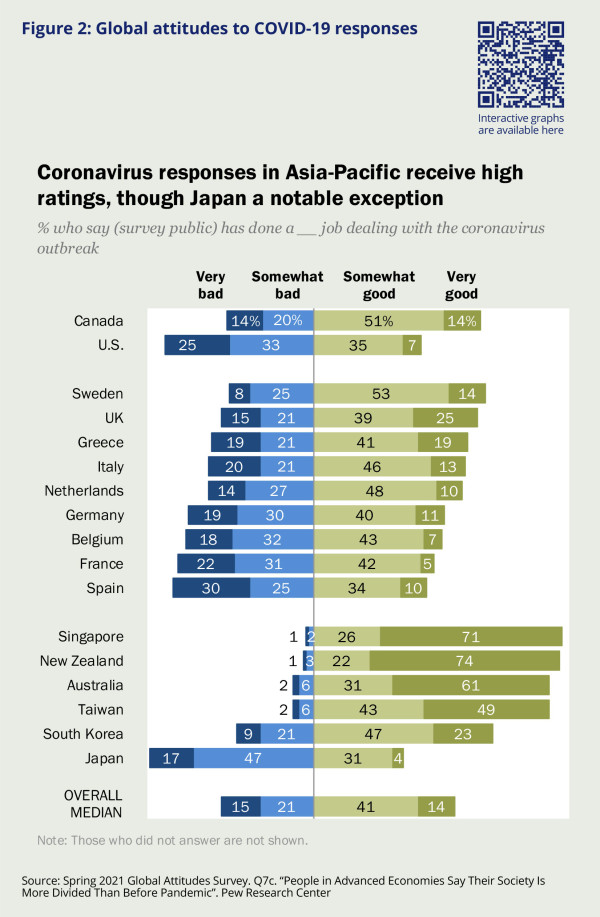
Another reason for the lack of strategic agility was the nature of elimination strategies. Elimination strategies, especially when successful, were very popular. The Labour Party formed the first ever majority government under the Mixed-Member Proportional electoral system in October 2020, arguably due in significant part to the management of the pandemic.1000 Early successes in managing COVID-19 similarly saw South Korea's ruling party re-elected in a 'landslide' in 2020.1001 An international public opinion survey conducted in 2021 found a 'strong relationship between how positively one assesses their handling of the pandemic and the number of virus-related deaths in that society'.1002 Similarly, 97 percent of Singaporeans, 96 percent of New Zealanders, 92 percent of Australians and 92 percent of Taiwanese believed that their countries had done a 'somewhat good' or 'very good' job in dealing with the coronavirus outbreak.1003
Figure 2: Global attitudes to COVID-19 responses
Perhaps because of this popularity, every jurisdiction that applied similar strategies to New Zealand's (also known as 'zero-' or 'low-COVID') found strategic transitions difficult. Public opinion in South Korea and Taiwan was initially divided over the merits of moving towards a 'living with the virus' management approach.1004 Leaders of Australian states and territories that had not experienced lengthy lockdowns were openly critical of the plan to reopen the country, and Western Australia kept its border closed until March 2022.1005 Some countries that had announced plans for reopening (such as South Korea and Singapore) had to pause progress or reverse course as infections grew faster than anticipated.1006
These difficulties are arguably inherent to elimination strategies. As a World Health Organization executive director noted in 2021, countries with successful elimination strategies can have a harder time exiting the pandemic, because of the unpalatable choice they face:
It is a difficult decision now for many countries who have managed to keep a very low or a zero-COVID strategy in place for so long to open up again, with the possibilities – and in fact, the probability – that disease may be reimported from other countries in which the disease is not under control.1007
A report by Te Niwha (New Zealand's infectious diseases research platform) on likely future pandemic agents and scenarios noted that strategy development in a pandemic 'is likely to be an iterative process as more information becomes available' and 'elimination is likely to be temporary…accompanied by an "exit plan" for when and how to shift to a suppression or mitigation strategy.1008 In future, New Zealand needs institutions that promote this flexibility and agility.
In its considerations of this issue, Phase One of this Inquiry recommended the establishment of a 'central agency function', which would 'coordinate all-of-government preparedness to respond to pandemics'.1009 This function would, among other things:
- 'coordinate the development of a range of pandemic scenarios to guide preparedness and response planning'
- develop an 'all-of-government pandemic response plan', which would provide 'guidance on how to develop and ensure there are pathways and transitions through all stages of the response through to exit', and
- develop an 'all-of-government response structure that can be quickly stood up in a pandemic where the lead agency does not have the capacity and capability to coordinate the response', including a 'separate strategy function that has the capacity to lead high-level planning for different planning for different phases of the response, including planning for transition and exit.1010
We agree that having strong strategic capability in the public service will be necessary for effective pandemic responses in the future, and that it makes sense to locate a pandemic response strategic function in a central agency. In particular, based on the experience of COVID-19, we consider that New Zealand will need to have the capability to think strategically over multiple timeframes (ie, short-, medium- and long-term), test and challenge existing strategies, undertake scenario planning, engage with and be open to outside expertise and perspectives, and be shielded from the pressures and distractions of day-to-day operations.
The question is whether an enduring function and capability can be established ahead of a pandemic, or whether it should simply be stood up in the event of a pandemic. Establishing a new agency and function in the midst of an emergency is less than ideal. Organisations are more likely to be effective where they have established relationships and processes. Building these from scratch and at pace during a pandemic would be particularly challenging.
However, it is hard to sustain interest, funding and capability for functions that are not regularly in high demand. Strategic planning units are often the first teams or functions to be downsized or wound up in government departments when fiscal savings are sought. And while there have been steps taken in recent years to encourage more long-term thinking from government agencies,1011 it has been argued that New Zealand has 'a generally weak approach to long-term policy development.1012 We tend to agree. In comparison with other similar countries, New Zealand's public service lacks a strong strategic function at the centre of government. This means that strategic and long-term thinking within the public service can be 'siloed'.1013
In our view, the best possible outcome would be to have both strong capability, and demand from ministers, for strategic thinking at the centre of government. It should be permanent, as it is easier to scale up an existing, well-functioning enterprise than to set one up afresh in a hurry. The strategic function should have responsibilities beyond pandemic preparation and response, so that it can build up and maintain its capability and develop strong relationships with decision-makers and other agencies. Greater strategic thinking as an ordinary process of government could benefit a range of activities and issues. Recommendation 1D below calls for the establishment of such a function.
There are a number of places in government where this capability could be placed. In most large businesses or public service departments, strategic planning functions are usually located either in the finance section or as a support to the senior leadership team. The closest analogies in government would be the Treasury or the Department of Prime Minister and Cabinet.
Given the scale of challenges facing agencies and decision-makers during a pandemic, a 'belt and braces' approach may be required to ensure the proper attention is given to developing and adapting strategic direction. Therefore, Recommendation 1E includes that regular, transparent and externally-triggered reviews of strategic settings will be important to support timely transitions during a future pandemic.
We do not have a firm view on how such reviews should be triggered and who would be responsible for them: the answers will probably depend on the circumstances of the next pandemic. We considered whether the central agency with the permanent strategic function should be given rights to set and overturn pandemic strategies but concluded that this would be inconsistent with the values of democratic accountability. Decisions about strategies in a pandemic inevitably involve judgements about the value of lives and social resources, and these rights are most appropriately vested in people who are accountable to the people.
What is needed is some form of creative tension in the system, which respects the rights of elected officials to govern but prompts them, in an open way, to regularly review and report on the adequacy of strategic settings. Some possible options are statutory triggers or the establishment of an independent expert board, whose members are shielded from removal by ministers.1014
L1.4 What we think is needed: data and modelling to support good decisions in a future pandemic
Ā mātou whakaaro mō ngā mea e hiahiatia
ana: he raraunga me te tauira hei tautoko i te whakatau tika i tētahi mate urutā anamata
L1.4.1 Capacity to stand up epidemiological modelling of the health impacts of public health measures
Te āheinga ki te whakatū tauira tahumaero hei aromatawai i ngā pānga hauora o ngā kaupapa hauora tūmatanui
Epidemiological modelling underpinned advice and decisions through the COVID-19 pandemic, and will be critical in any future pandemic response. In an emerging future pandemic, the government will need to rapidly stand up epidemiological modelling to inform decision-making under ongoing pressure. As the COVID-19 experience showed, time is of the essence at the beginning of a pandemic – a delay in decisions to implement public health measures can rapidly increase adverse health outcomes. Epidemiological modelling is essential to understanding the effectiveness of public health measures in reducing adverse impacts of a pandemic.
Expertise on epidemiological modelling in New Zealand is mostly held by staff in universities who specialise in public health. These experts participate in informal and formal networks with each other, and with international experts, which helps them keep up-to-date with international developments in modelling and to get peer review of their own work. In the early days of the pandemic these networks helped create an effective modelling approach that reflected New Zealand's specific circumstances.1015
In normal times, public sector advisers to government do not need to develop close relationships with public health experts in modelling the epidemiology of human respiratory viruses. Also, datasets relevant to constructing epidemiological models are likely held across different government agencies and beyond. These conditions could delay the establishment of effective models in a future pandemic, making it prudent for the government to maintain a capacity to do so.
The Government should task the permanent strategic function (see Recommendation 1D) with identifying the specific capacities needed to stand up epidemiological modelling in a future pandemic, maintain a watching brief on the extent to which those capacities are held in New Zealand, and identify a host agency with the potential to stand up modelling when required. This will likely require funding for a potential host agency to maintain the minimum necessary readiness to stand up epidemiological modelling.
Suitable host agencies include, for example, relevant Centres of Research Excellence in universities or the New Zealand Institute for Public Health and Forensic Science (formerly the Institute of Environmental Science and Research), a government-owned research organisation with a focus on the health, wellbeing and safety of communities.
L1.4.2 Improved estimates of the expected impacts of public health measures on business activity, employment and on social and education outcomes
Ngā matapae pai ake mō ngā pānga o ngā kaupapa
hauora tūmatanui ki te pakihi, te mahi, me ngā
putanga pāpori me te mātauranga
The epidemiological models discussed above can be used to show the expected impacts of public health measures on health outcomes and are updated using real time data, such as on current case numbers, hospitalisations and deaths. Understandably, no equivalent models exist to forecast the impacts of public health measures on outcomes such as business activity, employment, social wellbeing and educational achievement. Such outcomes are complex, context-specific and difficult to forecast in novel circumstances.
Estimates of the impacts of public health measures on economic and social outcomes need to disentangle the effects of other factors, such as the pandemic itself, changes in other government policies, changes in the international economy and many possible other influences on outcomes. Reliably estimating impacts on business activity, employment and on social and educational outcomes requires skill in the use of comprehensive datasets that contain a relatively large range of variables and cover sufficiently long periods of time.
Research we conducted demonstrates that New Zealand datasets – in this case, StatsNZ's Integrated Data Infrastructure database and Longitudinal Business Database – could be used to better understand the impacts of public health measures on a range of future pandemic scenarios. Results from research like this could give decision-makers in a future pandemic better and more systematic information on expected impacts. They will then have a better insight into the implications of their decisions that will help them mitigate adverse impacts (either by changing the design and mix of policies up-front or by providing more support for recovery). Robust estimates across a wider range of desired outcomes, will help decision-makers better identify the trade-offs.
For example, the StatsNZ databases we used in our own research helped us identify the impacts on future employment and earnings experienced by people who were subject to occupational vaccine mandates and had not been vaccinated by the mandate deadline. We also used these databases to carry out research on the effects of the 2021 Auckland lockdown on business survival and revenue.1016
The Integrated Data Infrastructure database contains a wide range of de-identified administrative and survey microdata on individuals and households, while the Longitudinal Business Database holds linked data about businesses. Both contain data covering more than a decade (longer for some measures). Importantly, they fully cover the COVID-19 pandemic period and afterwards. A wide range of other data sources are available that can help improve understanding of the impacts of public health measures. As an example, we commissioned the New Zealand Council of Educational Research to examine the effect of lockdowns on school learning achievement, using their databases.1017 Banks and other private sector organisations are further sources of useful information.
We have identified projects on COVID-19-related topics that government and other researchers undertook using the Integrated Data Infrastructure during 2020 and 2021 (see Chapter 2.4, section 2.4.7.3). More work using this valuable resource would better inform future decision-makers about the expected economic, social and education impacts of interventions like lockdowns, other alert level restrictions and vaccine mandates.
We consider that the permanent strategic function described in Recommendation 1D should promote a programme of research on the impacts of public health measures implemented during the COVID-19 pandemic on key social and economic outcomes. A primary focus should be on developing estimates of expected impacts of these measures to help decision-makers in a future pandemic take a well-informed and balanced approach. However, research of this kind may also stimulate debate on identifying and collecting new datasets, which would be helpful for measuring the impact of public health measures. Such a programme would require adequate funding and involve a range of relevant agencies both inside and outside government (such as universities and non-government research organisations).
L1.4.3 Greater agency capacity to monitor the impacts of public health measures, using real-time data
Te āheinga pakari ake ki te aroturuki i ngā pānga o ngā kaupapa hauora tūmatanui, mā te raraunga wā-tūturu
Once public health measures are implemented, decision-makers need timely information about their impacts on those affected, across a range of outcomes. This will help decision-makers to decide whether to continue such measures and, if so, whether to modify them to ameliorate adverse impacts. Monitoring outcomes will also help identify the need for further
measures to mitigate adverse impacts. For instance, during the lockdowns in late 2021, Cabinet and Ministers were taking decisions on the scope and strictness of measures at least weekly.
In Part 2, we sketched out examples of regularly provided information that could help decision-makers understand the social and other impacts on affected people of interventions such as lockdowns. These could include, for example, mental health indicators, measures of engagement with online learning, numbers of people accessing income support, food grants and in emergency housing.
Metrics like these would best be:
- provided regularly or consistently to decision-makers to allow assessment of changes or trends from week to week (or on a timescale relevant to circumstances and frequency of decisions)
- presented as raw numbers as well as percentage changes, to allow better understanding of the impacts
- provided for the regions affected as well as on a national basis.
- provided for vulnerable subpopulations such as Māori, Pacific people, people with disabilities, low-income households, isolated people and rural populations
- compared to metrics from the period before the interventions in question were put in place.
Such comparisons would help assess the extent and speed of any changes that had occurred. Understanding the pre-pandemic status quo is important because (as COVID-19 demonstrated) divisions and hardships already exist before a pandemic arrives. The permanent strategic pandemic function recommended below (Recommendation 1D) should initiate work among relevant agencies (including Stats NZ, the Ministry of Business, Innovation and Employment, the Treasury, the Ministry of Education, the Ministry of Health, the Ministry of Education, the Ministry for Women, the Ministry for Pacific Peoples and the Ministry for Ethnic Communities) to develop a suite of real-time metrics. This would help decision-makers in a future pandemic monitor the impact of their decisions on outcomes of concern.
L1.4.4 Stronger advice on weighing the impacts of public health measures in a future pandemic
He tohutohu pakari ake hei arotake i ngā pānga o ngā kaupapa hauora tūmatanui i tētahi mate urutā anamata
We have set out three separate initiatives, each designed to enhance advice to decision-makers in a future pandemic about the impacts of public health measures on outcomes of interest:
- ensure the capacity to undertake epidemiological modelling quickly in an emerging future pandemic
- strengthen estimates of the expected impacts of public health measures on key outcomes
- improve the data available to decision-makers in real time to monitor actual impacts of public health measures, once they have been implemented.
A fourth initiative, to bring these elements together, is of key importance. Future advice on public health measures must be well-structured and coherent to help decision-makers weigh the impacts across desired outcomes using appropriate metrics, and so to identify the important trade-offs. Advice must be presented and structured to allow efficient decision-making both during crises and when more measured decisions are possible.
The proposed strategic function at the centre of government should oversee work by relevant agencies (including the Ministry of Health, the Treasury, the Ministry of Business, Innovation and Employment, the Ministry of Social Development) to develop a framework for presenting advice on the impacts of public health measures in a future pandemic.
These agencies typically have well-established research functions, and large administrative data collections to support their operations and other statutory functions such as policy advice to their ministers. Administrative data collected by some of these agencies is de-identified and placed in the IDI (albeit with a delay), making it available for research. These agencies themselves undertake research using the IDI or commission other researchers to do so.
Preparation for a future pandemic will be a small part of the work of these agencies on data management, modelling and monitoring outcomes. Even so, we consider that the opportunity exists for a more strategic approach to marshalling data and modelling capabilities across responsible agencies to prepare for a future pandemic. Given scarce resources of skill and time, the strategic pandemic preparation function should help agencies prioritise their collective efforts and share resources where there are synergies in doing so.
L1.5 Recommendations: Systems that promote good government decision-making
Ngā Tūtohutanga: Ngā pūnaha e whakatairanga ana i te whakatau tika a te Kāwanatanga
Recommendation 1A:
Limit exemptions to produce regulatory impact statements
The Ministry for Regulation should limit exemptions from the requirement to produce regulatory impact statements in future pandemics, as far as possible, to decisions that are genuinely time critical.
Recommendation 1B:
Update the Cabinet Manual regarding prompt and regular reviews
The Cabinet Office should update the Cabinet Manual and/or CabGuide to require that all Cabinet decisions taken outside of regular quality assurance processes are promptly and regularly reviewed, ideally when the situation is less urgent.
Recommendation 1C:
Present elimination strategies as temporary
Decision-makers should explicitly present elimination strategies as temporary from the outset, including in the New Zealand Pandemic Plan. This would help shape and manage public expectations and create an impetus for forward planning.
Recommendation 1D:
Investigate a new strategic function
The Prime Minister and Minister for the Public Service should investigate establishing a permanent strategic function, either in the Treasury or the Department of the Prime Minister and Cabinet, and set up a clear work programme for that function.
Recommendation 1E:
Set aims for new strategic function to improve modelling, estimated impacts, data and a new framework for advice
The permanent strategic function at the centre of government should work with relevant agencies to:
- ensure the capacity to stand up epidemiological modelling quickly in an emerging future pandemic
- strengthen estimates of the expected impacts of public health measures on key health, economic, social and educational outcomes
- improve the data available to decision-makers in real time to monitor actual impacts of public health measures, once they have been implemented, and
- develop a framework for structuring advice to decision-makers in a future pandemic that enables them to effectively weigh impacts of public health measures across desired outcomes, and so to identify the important trade-offs.
Recommendation 1F:
Set an external trigger for regular and transparent strategic reviews
Decision-makers facing a severe pandemic should introduce an external trigger for regular and transparent strategic reviews. This could comprise:
- a statutory requirement to regularly review and report to Parliament on the adequacy of current pandemic strategic settings, and on anticipated future choices, and/or
- the establishment of an independent review board, which would review and report on pandemic strategies. Such a board should include expertise and perspectives from the public sector, the public health community and others from outside government.
Footnotes
980 Dean R. Knight, 'The effect of the COVID-19 pandemic on the democratic government ecosystem in Aotearoa New Zealand', Political Science vol. 77:1 (2025), https://doi.org/10.1080/00323187.2025.2517679, p 103
981 NZ Royal Commission of Inquiry into COVID-19 Lessons Learned: Phase One, Main Report (2024), Part 2 Section 2.6, https://www.covid19lessons.royalcommission.nz/reports-lessons-learned/main-report/part-two/2-6-our-assessment
982 NZ Royal Commission of Inquiry into COVID-19 Lessons Learned: Phase One, Main Report (2024), Part 2 Section 2.7, https://www.covid19lessons.royalcommission.nz/reports-lessons-learned/main-report/part-two/2-7-what-we-learned-looking-back
983 Dennis C. Grube, Why Governments Get It Wrong: and how they can get it right (London: Macmillan, 2022); Anthony King and Ivor Crewe, The Blunders of Our Governments (London: OneWorld Publishing, 2013); David Goddard, Making Laws That Work: How Laws Fail and How We Can Do Better (Oxford: Hart Publishing, 2022)
984 Cabinet Office Circular CO(24)7, Impact Analysis Requirements (16 December 2024), https://www.dpmc.govt.nz/sites/default/files/2024-12/co-24-7-impact-analysis-requirements.pdf
985 Cabinet Office, CabGuide, Cabinet paper consultation with Government agencies (29 September 2025), https://www.dpmc.govt.nz/publications/cabinet-paper-consultation-government-agencies
986 Cabinet Office, CabGuide, Cabinet paper consultation with Government agencies (29 September 2025), https://www.dpmc.govt.nz/publications/cabinet-paper-consultation-government-agencies
987 Cabinet Office, CabGuide: Government Expectations for Good Regulatory Practice (April 2017), https://www.regulation.govt.nz/assets/Uploads/Government-Expectations-for-Good-Regulatory-Practice.pdf
988 Cabinet Paper and Minute, CAB-21-MIN-0414, Education System Vaccination and Testing Requirements (11 October 2021); Cabinet Paper and Minute, CAB-21-MIN-0421, COVID-19 Confirming a Strategy for a Highly Vaccinated New Zealand (18 October 2021), https://www.dpmc.govt.nz/sites/default/files/2023-01/COVID-19-Confirming-a-strategy-for-a-highly-vaccinated-New-Zealand.pdf, p 17
989 The Treasury, Guidance Note - Regulatory impact analysis: exemptions for emergencies and post-implementation assessment/review for inadequate or missing impact analysis (June 2020), https://www.treasury.govt.nz/sites/default/files/2020-06/guidance-note-ria-exemptions-for-emergenciesand-post-implementation-options.pdf
990 Benjamin Davies and Arthur Grimes, 'COVID-19, lockdown and two-sided uncertainty', *New Zealand Economic Papers* Vol. 56:1 (2022), https://doi.org/10.1080/00779954.2020.1806340, p 49
991 Cabinet Paper and Minute, CAB-21-MIN-0414, Education System Vaccination and Testing Requirements (11 October 2021)
992 Key decisions that led to statutory orders under the COVID-19 Public Health Response Act were considered by the Regulations Review Committee. Section 14(5) of the Act also required that orders be kept under review. However, not all policy decisions considered in this phase of the Inquiry led to statutory orders.
993 NZ Royal Commission of Inquiry into COVID-19 Lessons Learned: Phase Two, engagement with Christchurch councils (23 June 2025); NZ Royal Commission of Inquiry into COVID-19 Lessons Learned: Phase Two, engagement with Auckland Council (9 June 2025); NZ Royal Commission of Inquiry into COVID-19 Lessons Learned: Phase Two, interview with Sir Ian Taylor (8 April 2025)
994 NZ Royal Commission of Inquiry into COVID-19 Lessons Learned: Phase Two, engagement with Auckland, Wellington and Christchurch City Missions (9 April 2025)
995 NZ Royal Commission of Inquiry into COVID-19 Lessons Learned: Phase Two, engagement with Auckland, Wellington and Christchurch City Missions (9 April 2025); NZ Royal Commission of Inquiry into COVID-19 Lessons Learned: Phase Two, engagement with Auckland Māori Healthcare Forum (11 June 2025)
996 NZ Royal Commission of Inquiry into COVID-19 Lessons Learned: Phase Two, interview with Rt. Hon. Chris Hipkins (4 August 2025); NZ Royal Commission of Inquiry into COVID-19 Lessons Learned: Phase Two, interview with Rt. Hon. Chris Hipkins (15 September 2025); NZ Royal Commission of Inquiry into COVID-19 Lessons Learned: Phase Two, interview with Rt. Hon. Dame Jacinda Ardern (30 July 2025)
997 NZ Royal Commission of Inquiry into COVID-19 Lessons Learned: Phase One, Main Report (2024), Part 2 Section 2.6, https://www.covid19lessons.royalcommission.nz/reports-lessons-learned/main-report/part-two/2-6-our-assessment
998 NZ Royal Commission of Inquiry into COVID-19 Lessons Learned: Phase One, Main Report (2024), Part 2 Section 2.6, https://www.covid19lessons.royalcommission.nz/reports-lessons-learned/main-report/part-two/2-6-our-assessment
999 NZ Royal Commission of Inquiry into COVID-19 Lessons Learned: Phase Two, interview with Dr Ian Town (1 May 2025)
1000 Jack Vowles, 'Shock, Bounce, and Reward?' in Jennifer Curtin, Lara Greaves and Jack Vowles (eds), A Team of Five Million: the 2020 'COVID-19' New Zealand General Election (ANU Press: 2024), http://www.jstor.org/stable/jj.17286118.9
1001 Justin McCurry, 'South Korea's ruling party wins election landslide amid coronavirus outbreak', The Guardian (16 April 2020), https://www.theguardian.com/world/2020/apr/16/south-koreas-ruling-party-wins-election-landslide-amid-coronavirus-outbreak
1002 Kat Devlin, Moira Fagan and Aidan Connaughton, 'People in Advanced Economies Say Their Society is More Divided than Before Pandemic', Pew Research Center (23 June 2021), https://www.pewresearch.org/global/2021/06/23/people-in-advanced-economies-say-their-society-is-more-divided-than-before-pandemic/
1003 Kat Devlin, Moira Fagan and Aidan Connaughton, 'People in Advanced Economies Say Their Society is More Divided than Before Pandemic', Pew Research Center (23 June 2021), https://www.pewresearch.org/global/2021/06/23/people-in-advanced-economies-say-their-society-is-more-divided-than-before-pandemic/
1004 Choe Sang-Hun, 'South Korea, a virus success story, now finds its model unsustainable', *The New York Times* (17 February 2022), https://www.nytimes.com/2022/02/17/world/asia/south-korea-covid-spread.html; Clarissa Wei, 'The topsy-turvy end of zero Covid in Taiwan', The New Yorker (23 May 2022), https://www.newyorker.com/news/dispatch/the-topsy-turvy-end-of-zero-covid-in-taiwan
1005 Ben Westcott, 'Australia beat the world on shutting out Covid. Now it is bitterly divided on how to reopen', CNN World (3 September 2021), https://edition.cnn.com/2021/09/03/australia/covid-zero-showdown-intl-dst-hnk; Narelle Towie, 'Western Australia border reopens after 697 days as the 'hermit state'', The Guardian (2 March 2022), https://www.theguardian.com/australia-news/2022/mar/02/western-australia-border-reopening-tests-mcgowan-as-covid-peak-looms
1006 Al Jazeera, 'South Korean reimposes COVID-19 curbs amid "mayhem" at hospitals' (16 December 2021), https://www.aljazeera.com/news/2021/12/16/s-korea-reimposes-covid-19-curbs-amid-mayhem-at-hospitals; Aqil Haziq Mahmud, 'No easing of restrictions for now amid spike in COVID-19 cases: Lawrence Wong', CNA (September 2021), https://www.channelnewsasia.com/singapore/covid-19-no-easing-restrictions-lawrence-wong-2154951
1007 Alan Kohler and Marty McCarthy, 'As we enter a post-pandemic world, Australia's "Zero COVID" approaches leaves us with a dilemma', ABC News (13 June 2021), https://www.abc.net.au/news/2021-06-13/australia-zero-covid-public-support-for-lockdowns-shifting/100203006
1008 Te Niwha, Likely future pandemic agents and scenarios: An epidemiological and public health framework (Dunedin: 2023), https://www.teniwha.com/assets/Uploads/Te-Niwha_Full-Report_Likely-future-pandemic-agents-and-scenarios_Web.pdf, p 94
1009 NZ Royal Commission of Inquiry into COVID-19 Lessons Learned: Phase One, Main Report (2024), Part 2 Section 11.4, https://www.covid19lessons.royalcommission.nz/reports-lessons-learned/main-report/part-three-moving-forward/11-4-complete-table-of-recommendations
1010 NZ Royal Commission of Inquiry into COVID-19 Lessons Learned: Phase One, Main Report (2024), Part 2 Section 11.4, https://www.covid19lessons.royalcommission.nz/reports-lessons-learned/main-report/part-three-moving-forward/11-4-complete-table-of-recommendations
1011 For example, the requirement under Schedule 6, section 8 of the Public Service Act 2020 for departmental chief executives to 'give a long-term insights briefing to the appropriate Minister at least once every 3 years … independently of Ministers'. See https://www.legislation.govt.nz/act/public/2020/0040/latest/link.aspx?id=LMS356994
1012 Koi Tū: The Centre for Informed Futures, Enhancing policy formation – Long term opportunities and challenges for Aotearoa New Zealand: Briefing for the incoming Prime Minister and Government (Auckland: October 2023), https://informedfutures.org/wp-content/uploads/2025/02/Koi-Tu-briefing-2023-enhancing-policy-formation.pdf, p 3
1013 Matt Boyd and Nick Wilson, 'Anticipatory Governance for Preventing and Mitigating Catastrophic and Existential Risks', Policy Quarterly, Vol. 17:4 (2021), https://doi.org/10.26686/pq.v17i4.7313, p 22
1014 For example, members could be appointed by the Governor-General and only able to be removed for 'just cause'.
1015 Shaun Hendy, The Covid Response: A Scientist's Account of New Zealand's Pandemic and What Comes Next (Wellington: Bridget Williams Books, 2025), p 37; NZ Royal Commission of Inquiry into COVID-19 Lessons Learned: Phase Two, interview with Shaun Hendy (19 May 2025)
1016 NZ Royal Commission of Inquiry into COVID-19 Lessons Learned: Phase Two, analysis of StatsNZ's Integrated Data Infrastructure and Longitudinal Business Database
1017 NZCER, analysis for the NZ Royal Commission of Inquiry into COVID-19 Lessons Learned: Phase Two (2026)